Pool Leak Detection in Brevard County, FL
Losing more than about a quarter inch of water a day is not evaporation. Confirm it in 24 hours with the bucket test below, see what a leak search and repair actually costs in Brevard County, then tell us what your pool is doing and we will put it in front of a local leak specialist.
Melbourne, Palm Bay, Viera, Suntree, Rockledge, Merritt Island, Satellite Beach, Indialantic, Melbourne Beach, Cocoa Beach, Titusville and the beaches.
How do I know if my pool has a leak?
Normal evaporation in Florida runs roughly a quarter inch a day. If your pool is losing noticeably more than that, or your auto-fill never shuts off, you likely have a leak. The bucket test below confirms it in 24 hours because it measures evaporation and your pool side by side.
The signs that most often turn out to be a real leak on a Brevard pool:
- Water level drops more than a quarter inch a day
- The auto-fill runs constantly, or the water bill jumps for no reason
- Soggy ground near the equipment pad, or a patch of lawn that stays wet
- Air bubbles coming out of the return jets
- Cracked deck, shifting coping, or tile pulling loose
- Chlorine demand keeps climbing and chemistry never holds
- Algae keeps coming back even though the chemistry looks right
A leak losing an inch a day is roughly 500 gallons on an average Brevard pool. That is a real water bill, and if the leak is in the plumbing it is also washing sand out from under your deck.
The bucket test: confirm a pool leak in 24 hours
Put a bucket of pool water on the pool steps, mark the level inside and outside, and wait 24 hours. Evaporation affects both equally. If the pool drops more than the bucket, the difference is your leak. It is the only free test that separates a leak from a hot week.
- Fill a five gallon bucket about three quarters full with pool water.
- Set it on the second step so the bucket sits partly submerged.
- Mark the water line inside the bucket and the pool level outside it.
- Turn the pump off and switch the auto-fill off. Do not swim.
- Come back in 24 hours and compare the two marks.
Both dropped the same amount, that is evaporation and your pool is fine. The pool dropped more than the bucket, you have a leak.
Then run it a second time with the pump on. If the pool loses more with the pump running, the leak is in the pressure side plumbing. If it loses more with the pump off, it is more likely the shell, the skimmer or the main drain. That one detail tells the tech where to start and it saves you money on the visit.
How is a pool leak actually found?
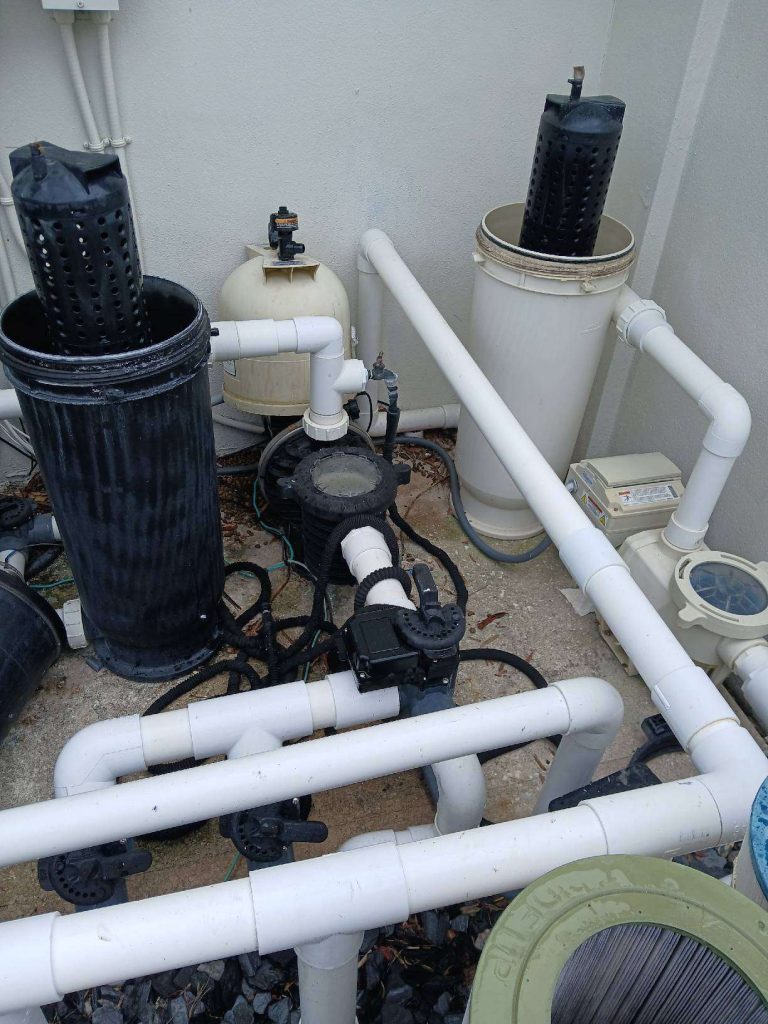
Leak detection is elimination, not guesswork. The job is to rule out evaporation, then separate a shell leak from a plumbing leak, then narrow the plumbing to a single run before anything gets cut or dug.
The order most leaks get found in:
- Rule out evaporation. Bucket test, and check whether the loss changes with the pump on or off.
- Check the usual suspects first. The skimmer throat, the light conduit, return fittings and the main drain account for a large share of pool leaks. These are visible checks that cost nothing to rule out.
- Separate shell from plumbing. Losses that stop at a particular water line point at that depth. Losses that track with the pump point at the lines.
- Narrow the plumbing. Suction and return lines get isolated and pressure tested one at a time so the repair is a small opening rather than a torn up deck.
- Repair and re-test. Fixing it is only half of it. The pool gets watched afterward to confirm the loss actually stopped.
Leaks at the skimmer or a return fitting are usually a same-day repair. A leak in a buried line takes longer and costs more, which is exactly why narrowing it down first matters. In Brevard the sand under a deck moves once water starts running through it, so a plumbing leak left alone turns into a deck problem.
What does pool leak detection cost in Brevard County?
A professional leak detection visit on a standard residential pool in Central Florida typically runs $275 to $450. The repair is billed separately: a skimmer or return fitting is often $100 to $250, a buried plumbing line runs $400 to $1,500, and structural shell work is $800 to $3,000. Locating the leak first is what keeps you out of the top of those ranges.
- Leak detection visit, standard residential pool: $275 to $450
- Larger or more complex pool: $350 to $450
- Skimmer, light conduit or return fitting repair: $100 to $250
- Pressure test to isolate a plumbing run: $200 to $500
- Buried plumbing line repair: $400 to $1,500
- Structural or shell repair: $800 to $3,000
What pushes a job to the top of the range: a line running under a deck, driveway or patio that has to be cut and re-poured, a leak that has already washed sand out and dropped the deck, and any pool where several small leaks are stacking up rather than one obvious one.
Two things worth asking before you book anyone: whether the detection fee is credited toward the repair, and whether they do the repair themselves or hand you a report and leave. Both vary by company and both change what you actually pay.
These are Brevard-area market ranges for planning, not a quote. Your price comes from the company you hire.
Pool leak detection across Brevard County
We cover Brevard County from Titusville down to Micco, including Melbourne, Palm Bay, Viera, Suntree, Rockledge, Merritt Island, Satellite Beach, Indialantic, Melbourne Beach, Cocoa, Cocoa Beach, Palm Shores and Malabar.
Beachside pools have their own pattern. Salt air is hard on fittings and equipment, and shifting sand behind a shell shows up differently than a leak in an inland pool sitting on more stable ground. It is worth telling whoever comes out which side of the river you are on.
Barrier island and riverfront pools also sit on a high water table, which is why draining a Florida pool to chase a leak is a last resort rather than a first step.
Think you have a leak? Tell us what you are seeing.
Run the bucket test first if you can. It takes a day and it tells the tech where to start. Send the details and we will get them to a Brevard leak detection company.
Brevard Pool Leak is a referral service, not a pool contractor. We pass your details to a local leak detection company and you hire them directly.
Pool leak questions Brevard homeowners ask
Roughly a quarter inch a day from evaporation, more in a hot windy week and less if the pool is shaded or covered. Losing half an inch or more a day consistently is a leak, not weather. The bucket test settles it in 24 hours.
Yes, in most cases. Draining a Florida pool is a last resort and it carries its own risk, because an empty shell can shift or pop out of the ground where the water table is high. The point of a proper leak search is to narrow the location down so nothing unnecessary gets drained, cut or dug.
A straightforward diagnostic is usually one to three hours on site. Pools where several lines have to be isolated and pressure tested one at a time can take most of a day. Summer is the busiest stretch for leak work in Brevard, so scheduling is generally quicker in the cooler months.
Not always, and it is the first thing to ask. Some companies locate and repair; others locate only and hand you a report to take elsewhere. Skimmer, light conduit and return fitting repairs are often done the same day. A buried line under a deck usually becomes a second scheduled visit with its own quote.
Sometimes, and it depends on your policy and on what the water damaged rather than on the leak itself. Many policies cover resulting damage but not the failed pipe or fitting. Check with your carrier before work starts, and ask for written documentation of what was found. We are not insurance advisors.
Usually for at least part of it. The tech needs gate access, access to the equipment pad and power. Most will want to hear what you have been seeing before they start, and you want to be there at the end when they show you what they found and what it will take to fix.
Often yes. A pool that is constantly topping off with fresh water is constantly diluting its chemistry, so chlorine never holds and algae gets a foothold. Fixing the chemistry without fixing the leak is a treadmill. Get the leak sorted first, then the green clears and stays clear.